Epiphany DSP
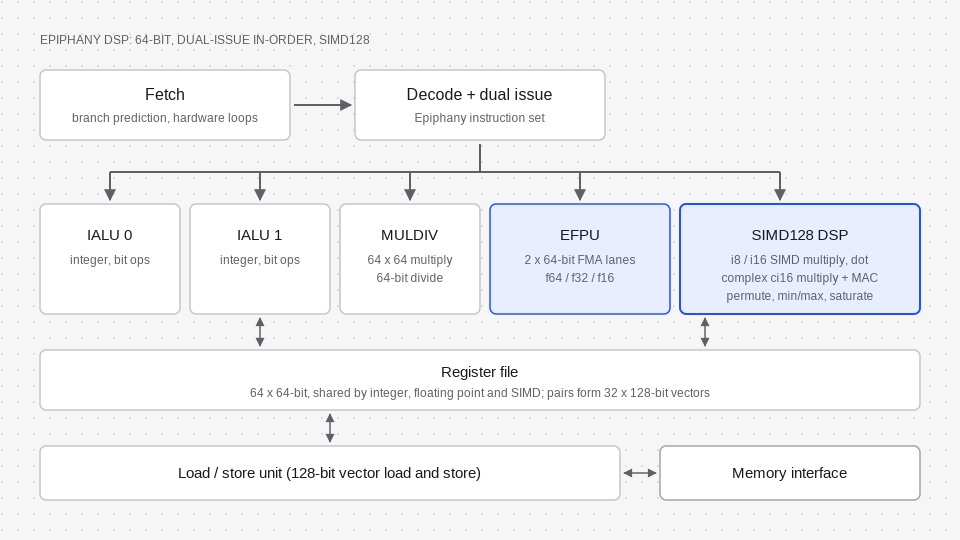
The Epiphany DSP core is a parametric 64-bit dual-issue in-order processor IP core for signal processing, based on the Epiphany instruction set and the SIMD128 extension. SIMD128 is a new 128-bit instruction set extension for floating point, integer and complex arithmetic.
Value Proposition
- 128-bit SIMD: f64, f32 and f16 floating point and i8 and i16 integer vectors
- Complex arithmetic: packed complex (ci16) multiply and multiply-accumulate, four complex values per operation
- Large register file: 64 x 64-bit registers, shared by integer, floating point and SIMD code
- Dual issue: two instructions per cycle, with branch prediction and zero-overhead hardware loops
- Configurable: register count, data width, floating point and accelerator slots are selected at build time
Core Summary
| Feature |
Epiphany DSP |
| ISA |
E64 + SIMD128 |
| Width |
64-bit |
| Pipeline |
dual-issue, in-order |
| Register file |
64 x 64-bit |
| Vector registers |
32 x 128-bit (register pairs) |
| Memory |
local SRAM, instruction cache and data cache, sizes configurable |
| Floating point |
f64, f32, f16, fused multiply-add |
| Integer SIMD |
i8, i16 |
| Complex |
ci16 multiply and multiply-accumulate |
| Program flow |
branch prediction, hardware loops |
| CoreMark |
4.90 CoreMark/MHz |
| Peak performance |
32 GOPS (i8), 16 GOPS (i16), 8 GFLOPS (f32), 4 GFLOPS (f64) at 1 GHz |
| Clock target |
1 GHz |
SIMD128 Instruction Set
| Category |
Operations |
| Floating point |
add, subtract, multiply, fused multiply-add, min/max, compare, conversions |
| Integer |
multiply, multiply-accumulate, dot product, averaging add/subtract, saturating arithmetic |
| Complex |
complex add/subtract, multiply, multiply by conjugate, multiply-accumulate |
| Fixed point |
rounding and saturating narrowing |
| Data movement |
permute, zip/unzip, extract |
Applications
| Area |
Kernels |
| Communications |
complex FIR, mixer, correlation, FFT, equalizer, beamforming, power |
| Linear algebra |
GEMM, GEMV, dot product, AXPY |
| Signal processing |
FIR, biquad, FFT, matrix, statistics |
| Audio |
FIR and biquad filters, FFT |
| Image and video |
saturating blend, absolute difference, min/max |
| Category |
Content |
| Compiler |
GCC compiler, assembler, linker |
| Debugger |
GDB source-level debugger |
| Simulator |
GDB instruction set simulator |
| Math Library |
ZKL math and DSP kernel library |
| Build Automation |
SiliconCompiler Python-driven build system |
| Emulation |
Switchboard system emulation |
IP Deliverables
| Deliverable |
File format |
| Datasheet |
PDF, HTML |
| Integration Guide |
PDF, HTML |
| RTL |
Verilog |
| Timing constraints |
SDC |
| Testbench |
Verilog |
| Build scripts |
SiliconCompiler (Python) |
Heritage
The Epiphany architecture has been proven in silicon across several generations of Epiphany processors, up to the 1,024-core Epiphany-V.
Access Model
The Epiphany DSP core is available via commercial IP agreements. Contact our team to learn more about licensing terms and availability.